The great Matt Shenton invited me to join him on his Paid Search NYC Podcast.
The recording will be shared later. For today, I wanted to repeat a question he asked me:
“What is an agent?”
Before I answer, I’d like you to know that I studied Artificial Intelligence back in the 90s. Back then, “AI Agents” were a hot topic. I’ve even written a thesis about “reinforcement learning in multi-agent systems.” Back then, just as today, the term “agent” wasn’t clearly defined and was a topic of debate.
So, Matt’s question invited me to open the hatch to the hold on my houseboat, to look for my thesis, and find the definition I used back then.
Here’s what I had said:
Cooperation in Multi-Agent Systems
Communication and Cooperation in a system of multiple Q-learning agents
Nils Rooijmans
June 9, 2000Chapter 1 – Introduction
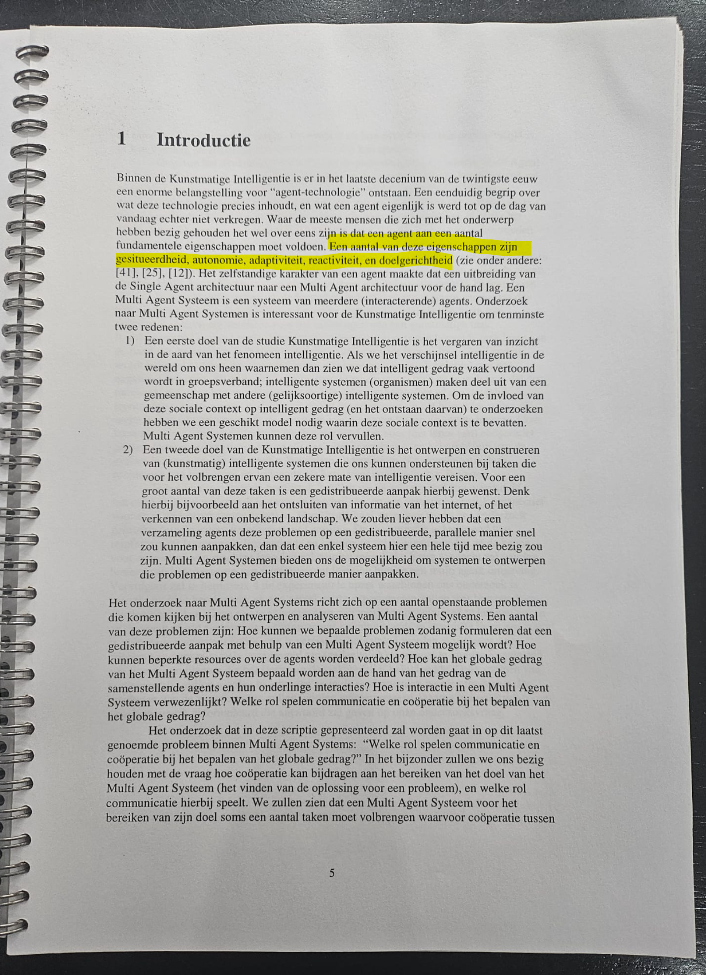
Within Artificial Intelligence, in the last decade of the twentieth century, there has been a significant rise of “agent technology.” A clear definition of what this technology exactly entails, and what an agent actually is, has not been established to this day.
Where most people who have studied the subject agree, however, is that an agent must satisfy a number of fundamental properties. Some of these properties are autonomy, adaptability, reactivity, and goal-directedness.

Here’s what I would say today: an (AI) agent is a system that pursues goals through autonomous adaptive decision-making and action.
Let me break this down for more clarity.
An agent combines these elements:
- State awareness: it observes some kind of environment (e.g., your Google Ads account or your product inventory) and updates its internal representation of this environment
- Reasoning: it interprets what it “sees” and decides on the best next step (e.g., impression share is low for keywords in this ad group, or product X is running out of stock)
- Actions: it can take actions that manipulate its environment, without being micromanaged at every step (e.g., add price extensions to your ad group, or order a next batch of products)
- Goal-directed: it maintains alignment to a specified goal or objective, and continues acting until the goal is reached or conditions change (e.g., maximize revenue as long as POAS > 150%, or keep stock levels to a minimum without running out of stock on the top sellers that generate 80% of revenue)
- Adaptive: it evaluates the results of its actions and uses these insights to improve its decision-making (e.g., adding price extensions resulted in a significant increase in impression share for 8 out of 10 ad groups, so in the future, let’s do that more often)
– Nils